
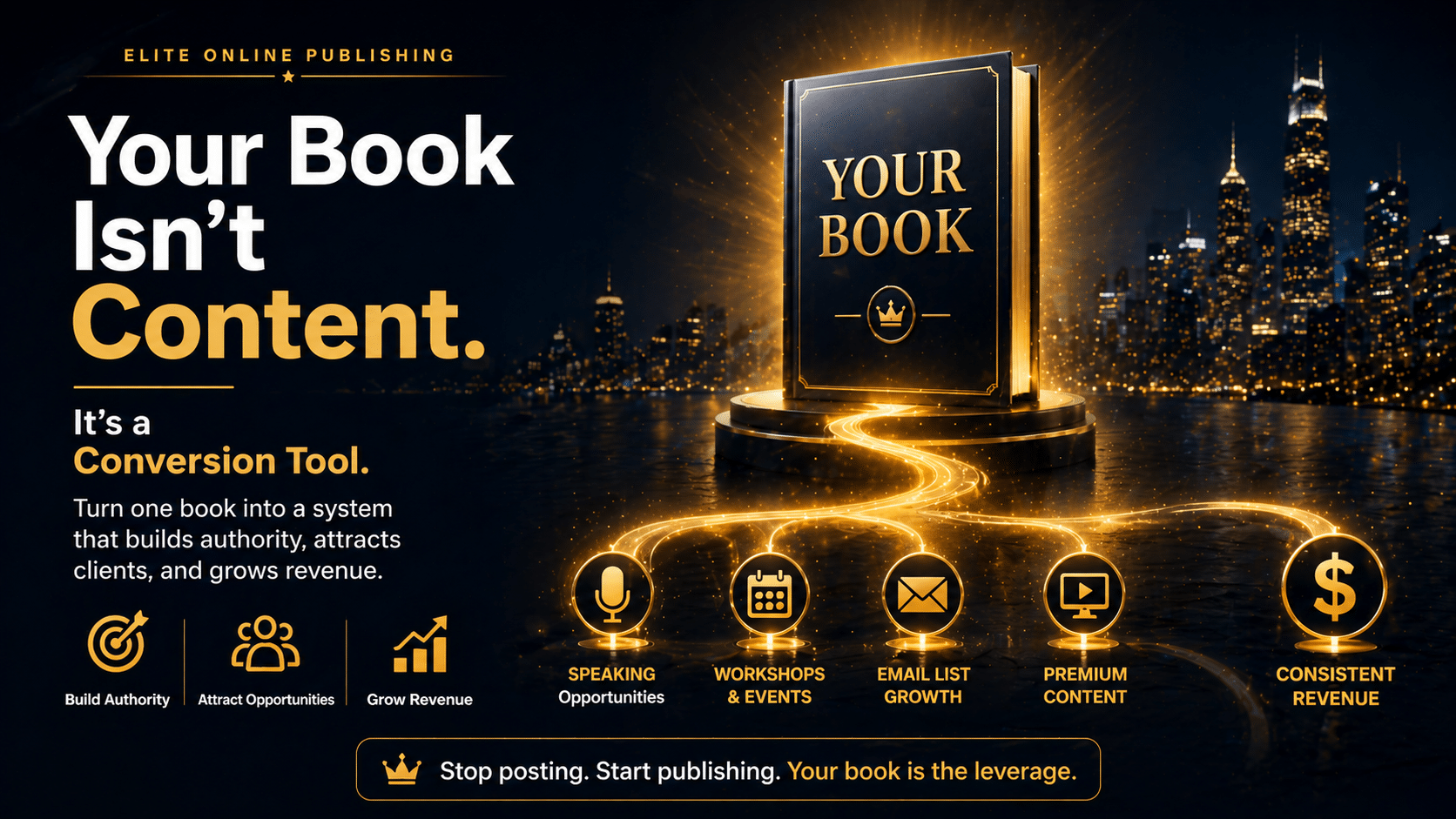
Most experts treat their book like a long blog post.
That is why most expert books don’t make money.
A book is not content. Content is what fills your feed. A book is an asset. Specifically, it is a conversion tool. And the experts who treat it that way build entire businesses on the back of one well-positioned title.
The Difference Between Content and a Conversion Asset
Content gets consumed and forgotten. A book gets bought, read, gifted, referenced, cited, displayed on a desk, mentioned on a podcast, and quoted in a sales call. One piece of content might earn a like. One book reshapes how an entire market sees you.
A conversion tool is anything that takes someone from cold to warm to client. Most consultants and coaches piece this together with webinars, lead magnets, sales calls, and follow-up emails. A book does it on its own. Inside the pages, the reader meets you, learns your framework, sees themselves in the case studies, watches you solve a problem they have, and finishes the last chapter wanting to know how to work with you.
When the back of the book points to a clear next step, that book becomes the most efficient sales asset most experts have ever owned.
What This Looks Like in Practice
A speaker walks off stage and the audience already has the book. They didn’t just hear you. They have your full method in their hands. The follow-up call closes faster because the entire framework was pre-sold.
A premium prospect reads three chapters before the discovery call. They show up with implementation questions, not skepticism. The conversation skips the convincing phase and goes straight to scoping.
A podcast host references your book on air. Their audience trusts the host. The host trusts the author. The author is you. That stack of trust is something paid ads cannot manufacture.
A media producer searches your name and finds the book. It signals you’re a serious source. The interview becomes possible. The interview drives traffic to a funnel that leads back to a working offer.
A client gives the book to their executive team before signing the contract. Internal selling happens without you in the room. The deal closes faster.
Why Most Self-Published Books Underperform
None of those outcomes are accidents. They happen when the book is built as a conversion asset from day one. That means the chapters answer real client objections. The frameworks match the offer. The case studies map onto the buyer profile. The back matter routes readers somewhere specific. There is a funnel attached.
This is also why most self-published expert books underperform. Not because the writing was bad. Because the strategy was missing. A great book without a system around it is a great souvenir. A good book with a real conversion system around it is a business engine.
The shift here is not “write a better book.” It is “design the book as part of a revenue system from the start.”
See How the System Comes Together
Our team works with experts on this every week. You can learn more or reach out here and we’ll walk you through the model.
For a deeper look at the strategy in action, our YouTube channel breaks down the full Authority-to-Pipeline framework, including how clients turn book sales into speaking deals, premium clients, and media features.
FAQ
Can a book really replace marketing?
No. It anchors marketing. A book sits at the center of an authority platform. Around it sits podcasting, speaking, social, and email. The book gives the rest of the system gravity.
How do I make sure the book actually converts?
Build the offer and audience clarity first. The chapters answer their real objections. The case studies look like them. The back of the book points somewhere clear. That is the conversion architecture.
What if I don’t sell anything besides services?
Service businesses see the strongest book ROI of any category. The book replaces a lot of the trust-building usually done in long sales cycles, which is exactly where service businesses lose deals.


0 Comments